You've most likely heard the terms neonatal intensive care unit (NICU) and pediatric intensive care unit (PICU). But what do they mean? Whether you're a registered nurse (RN), respiratory therapist, or another medical professional, knowing the difference between the NICU and PICU is probably important to your career. Here's what you need to know about these two areas of the nursing profession.
- What is a NICU
- What does a NICU nurse do?
- NICU nurse job outlook
- What is a PICU?
- What does a PICU nurse do?
- PICU nurse job outlook
- The differences between NICU and PICU
- ✨ BONUS ✨ Frequently asked questions
NICU vs PICU: What's the Difference?
What is a NICU?
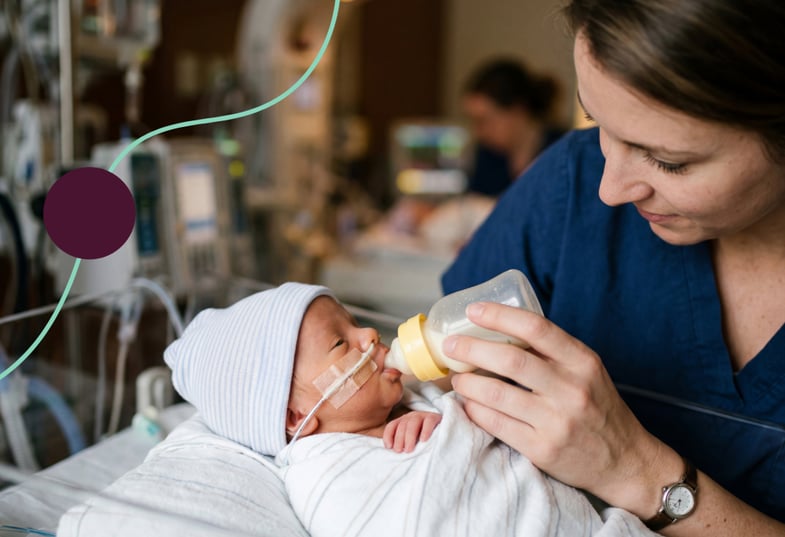
A neonatal intensive care unit is a specialized hospital department designed to care for newborns who need extra medical support right after birth. Most NICU patients are premature, medically fragile, or recovering from a complicated delivery. NICUs range from Level II special care nurseries handling milder cases to Level IV units equipped for the most complex neonatal surgeries and conditions.
What does a NICU nurse do?
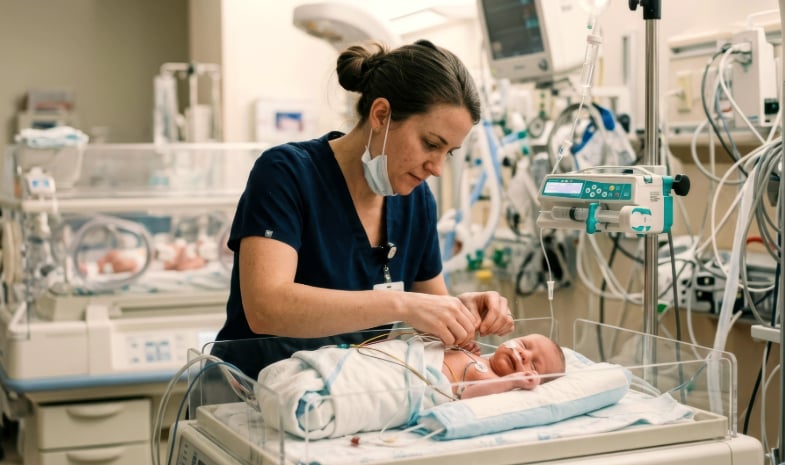
So, now that you know what a NICU is, let's explore what a NICU registered nurse does. NICU nurses monitor tiny, fragile patients around the clock, tracking vital signs, feeding tolerance, and oxygen levels for cues that a baby can't communicate on their own.
NICU nurses are more than caregivers. They're often the steadiest presence in the room for parents facing one of the most frightening chapters of their lives, translating monitors and medical jargon into something a scared new parent can actually hold onto.
Related: Why I Love Being a Critical Care Nurse with Gabby Harrington, RN
NICU nurse job outlook
If you're interested in working in the NICU, the broader nursing career outlook is encouraging. According to the U.S. Bureau of Labor Statistics, registered nurse employment is projected to grow 6% from 2025 to 2035, faster than the average for all occupations, and demand for neonatal specialists tends to track closely with that overall growth.
OR nurse career facts
- Job outlook: 👍👍
- Pay varies by facility, location, and experience
- Education requirements: bachelor’s degree commonly preferred
- Search for travel NICU RN jobs

What is a PICU?
A pediatric intensive care unit is a specialized hospital department that provides critical care for infants, children, and teenagers, covering a much wider age range and diagnosis list than the NICU. Kids end up in the PICU for reasons ranging from severe respiratory illness to post-surgical recovery to traumatic injury.
What does a PICU nurse do?
Want to be the nurse who steadies a family through a child's scariest hospital stay? A career as a PICU nurse may be the move for you.
Responsible for monitoring critically ill children of vastly different ages and conditions, PICU nurses adjust their approach constantly. Their duties include continuous vital sign monitoring, medication administration, recognizing early signs of decline, and communicating clearly with anxious parents and care teams alike.
PICU nurse job outlook
As with NICU, PICU demand tends to move with the broader growth projected for registered nurses nationally. Pediatric critical care remains a consistently needed specialty, since hospitals with pediatric units require around-the-clock coverage regardless of census swings.
PACU nurse career facts
- Job outlook: 👍👍
- Pay varies by facility, location, and experience
- Education requirements: bachelor’s degree
- Search for travel PICU RN jobs

The differences between NICU and PICU
Pace and patient population
While both the NICU and PICU are critical care environments, they ask something different of the nurses who work there. The NICU is steady and relationship-driven. A NICU nurse typically cares for the same one or two babies across a shift, building a slow, intimate familiarity with each patient's baseline.
The PICU moves differently. Patients range from infants to teenagers, and no two admissions look alike. A PICU nurse might go from a toddler recovering from pneumonia to a teenager post-trauma in the same shift, which demands quick recalibration.
Certifications
Aside from pace, another difference between the NICU and PICU is which certifications are most commonly associated with each. NICU nurses often pursue the NRP (Neonatal Resuscitation Program), and with more experience, some pursue RNC-NIC. PICU nurses more commonly hold PALS (Pediatric Advanced Life Support), and experienced PICU travelers sometimes pursue CCRN-Pediatric. Requirements vary by facility, so always confirm what a specific assignment expects.
Team structure and setting
Another thing that sets the NICU apart from the PICU is how the care team is organized. NICU teams often work in tight coordination with neonatologists and respiratory therapists within a single, specialized unit built entirely around newborn care.
In the PICU, the nurse frequently works alongside a broader pediatric care team, including surgeons or cardiologists depending on the case, since the patient population and reasons for admission vary so widely.
Frequently asked questions
What certifications are recommended for NICU and PICU nurses?
The certifications that make sense for you depend on your specialty. NICU nurses commonly pursue NRP, with RNC-NIC valued as experience grows. PICU nurses commonly pursue PALS, with CCRN-Pediatric valued for more seasoned travelers. To pursue either, nurses generally need an active RN license and eligible clinical hours, though requirements vary by facility and certifying body.
What nursing skills do NICU and PICU nurses need?
Being a NICU or PICU nurse demands a unique blend of skills. Most importantly, you need sharp observational instincts, since your patients often can't tell you what's wrong. You'll also need steady composure, since families in both units are frequently navigating some of the hardest days of their lives.
Clear communication matters just as much as clinical skill. Whether you're coaching a new parent through a NICU stay or updating a teenager's family in the PICU, you're translating high-stakes medicine into something a frightened family can understand and hold onto.
Can I switch between NICU and PICU as a travel nurse?
Switching happens, though it's not automatic. Because NICU and PICU serve different patient populations, most facilities want to see relevant experience or a completed specialty orientation before placing you in the other unit. Some travelers make the move gradually by picking up a mixed-unit assignment first. Talk to your recruiter early if a switch is on your radar, since requirements vary by facility and location.
Should I travel nurse with Fusion Medical Staffing?
Only you can decide what’s next for your career, but if travel nursing is on your radar, Fusion Medical Staffing is here to support the journey. Here’s what you can expect when you travel with us:
✨ A single point of contact, so you won’t be passed between multiple recruiters
✨ Day-one health, dental, and vision insurance, plus $0 copays for mental health services
✨ 401(k) matching up to 100% on the first 3% of your contribution
✨ 40 hours of paid vacation after 1,560 hours worked, which is roughly one 3- to 13-week assignment
✨ Reimbursement for certification, licensing, mileage, and continuing education
✨ Referral bonuses up to $500
Want to learn more about traveling with Fusion Medical Staffing? Fill out a quick application to connect with a recruiter.
Whether you see yourself in the OR or the PACU, both paths offer the chance to make a meaningful impact while continuing to grow your skills. If you’re ready to start your travel healthcare journey, connect with a Fusion Medical Staffing recruiter to find a role that fits what you’re looking for.