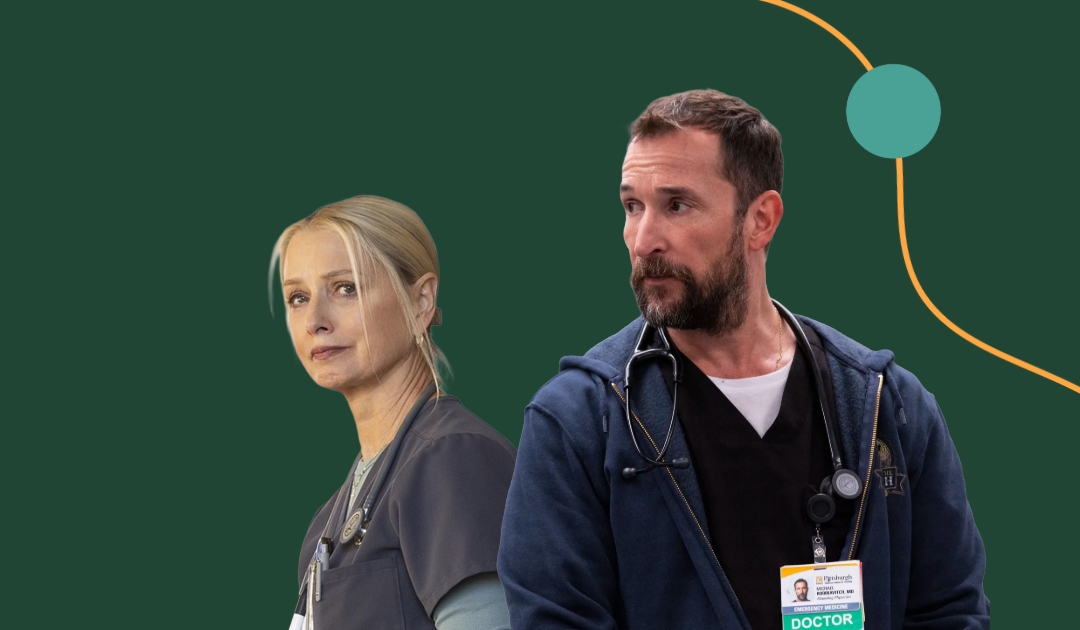
There's a scene in The Pitt where Nurse Dana Evans, the charge nurse holding the entire ER together, gets assaulted by a patient who's been waiting too long. Her colleagues are outraged. They're also not surprised. And then everyone just keeps going, because the board is full and there's no one to cover if they stop.
If you work in healthcare, you probably didn't flinch at that. You recognized it.
That's why the show has taken over every healthcare group chat since it premiered on HBO Max in January 2025. It won the Emmy for Outstanding Drama. It swept the Golden Globes. But the response that actually matters? The nurses and doctors and respiratory techs posting clips at 2am saying: this is it. This is exactly what it's like.
It's Not a Show About Medicine. It's a Show About a System.
Most medical dramas use the hospital as a backdrop for romance and heroics. The Pitt uses it as a mirror. Every episode is one hour of a single 15-hour shift in an underfunded Pittsburgh ER, and there are no tidy resolutions at the end of each one. Just a team doing everything they can inside a system that keeps asking more than it gives.
Executive producer and star Noah Wyle said he made it to shine a spotlight on frontline workers who have been going without a break since COVID, and to be honest about what that costs people. The show's creator R. Scott Gemmill talked to healthcare professionals about what keeps them up at night, and then he wrote that. The result is something that feels less like a TV show and more like a document. For a deeper look at the emotional toll of that kind of work, the story of Fusion travelers Jodi and Scott Maiers covers similar ground in a very real way.
The Waiting Room That's Never Empty
One of the quieter things the show does is keep the waiting room in frame. It's always full. It's always getting fuller. The people in it are getting more anxious, more frustrated, and eventually more dangerous. This isn't dramatic tension. It's Tuesday.
LA-based nurse Dan Taylor wrote about this for Entertainment Weekly, describing how the show captures the way patient volume and anxiety have both spiked in a post-pandemic world. The waiting room in The Pitt isn't a plot device. It's the whole problem, playing out in real time.
And here's what the show gets right that most don't: it's not the workers failing the patients. It's the system failing both of them, simultaneously, shift after shift.
What Chronic Understaffing Actually Looks Like From the Inside
The Pitt doesn't have a character named "The Staffing Shortage." It doesn't need one. You feel it in every scene. Dr. Robby fielding a resident's question while managing a trauma while being cornered by a hospital administrator asking about satisfaction scores. The nurses moving through the floor with no wasted motion because there is no margin for any.
This is what chronic understaffing looks like from the inside. Not a crisis moment. A permanent state. The kind of place where the team is already running at full capacity before the hard cases come in.
Travel nurses exist because of exactly this gap. When a unit is short, a skilled traveler doesn't just fill a slot. They bring experience, fresh eyes, and capacity that a burned-out permanent team can't always access anymore. That's not a band-aid. That's how modern healthcare staffing is supposed to work. Learn more about what travel nursing looks like with Fusion.
The Emotional Toll Is the Story
Dr. Robby carries the grief of losing his mentor to COVID four years earlier into every shift. Dr. Abbot is found on the rooftop in the first episode. The show doesn't frame these as dramatic backstory. It frames them as what happens when people are asked to hold too much for too long.
Amanda Choflet, dean of Northeastern University's School of Nursing, specifically praised the series for weaving mental health and substance abuse themes for providers into the story as central truths, not side plots. Healthcare workers have described certain scenes as triggering. Not because they're exaggerated. Because they're accurate. Some have used episodes to show family members what their shifts actually look like, since those family members aren't allowed in the building.
If any of this is landing close to home, that's worth paying attention to. Burnout doesn't announce itself cleanly. And for what it's worth: members of Fusion's own clinical team, many of them former nurses and clinicians themselves, watched The Pitt and felt it too. They're the people supporting our travelers on assignment, and they know what it's like to be on that side of the board because they've been there. Fusion's blog has an honest piece on recognizing the signs and what to do about them that's worth a read.
So, What Do We Do With All of This?
The Pitt is resonating because it's telling the truth. About what it costs to work in a system that's structurally underfunded. About the grief and the grit and the way good people keep showing up anyway, not because it's easy, but because the alternative is unthinkable.
If you're a healthcare worker watching this and feeling seen, good. You should. What you do is genuinely extraordinary and the gap between what you're asked to give and what you're given in return is real.
And if you've been thinking about travel nursing, this might be the moment to take that seriously. Not because travel fixes the systemic problems The Pitt is describing. It doesn't. But it gives you something the current system often doesn't: a choice. The ability to pick your environment, find facilities that are actually investing in their teams, and take a breath between contracts when you need one. The importance of that time off is something we talk about a lot, because we've seen what happens when people skip it.
Wyle said he made The Pitt to inspire the next generation to step into this work, because the system needs them. We'd add: it also needs the experienced ones to stay in it. Sometimes, travel is how that happens. If you're ready to find out what that looks like, browse travel nursing jobs with Fusion or reach out to a recruiter. We'd love to be part of your next chapter.